
A camping fridge works on the same principle as the one in your kitchen: a heat pump moves heat from inside an insulated box to the outside, so the interior stays a few degrees above freezing [1]. What changes on the road is how that pump is driven — most portable fridges use a 12V compressor, caravan-style units can run on gas through an absorption cycle, and passive coolers simply rely on insulation and ice [1][2].
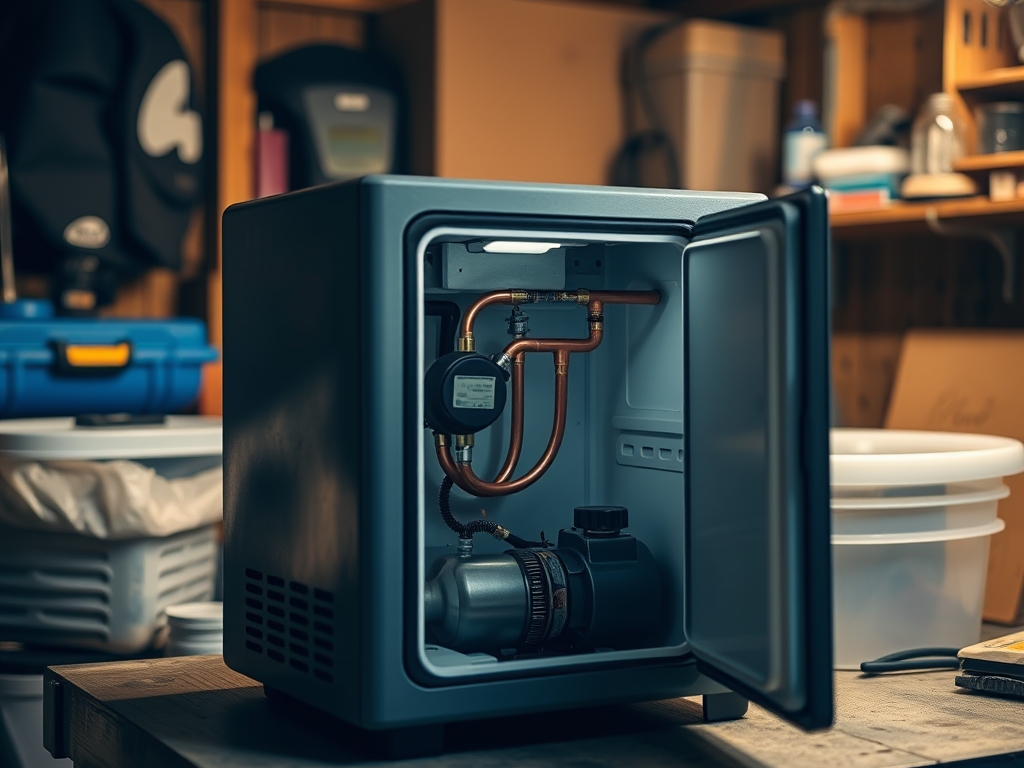
The basic principle: heat out, not cold in
A refrigerator is a thermally insulated compartment plus a heat pump — mechanical, electronic or chemical — that transfers heat from the inside to the external environment [1]. Nothing is “added cold”; heat is carried away. The low temperature reduces the reproduction rate of bacteria, which is why refrigeration slows spoilage [1].
A fridge holds a temperature a few degrees above the freezing point of water, and the optimal range for perishable food storage is 3 to 5 °C; a freezer is a refrigerator, or a section of one, that keeps its contents below freezing [1]. The United States Food and Drug Administration recommends keeping a refrigerator at or below 4 °C and a freezer at −18 °C [1].
Everything else around that hardware changes how hard it has to work. Insulation thickness, lid seal, how often you open it and how much warm food goes in all affect how often the pump runs to hold the same temperature. Two fridges with similar cooling gear can behave very differently in a hot car or a sun-baked campsite for that reason alone.
How does a 12V compressor camping fridge work?
Most household refrigerators, refrigerator-freezers and freezers use a vapour compression cycle [1], and a portable 12V fridge is the camping version of that idea: a compressor driven by DC power circulates refrigerant, and the cycle dumps heat through the condenser at the back or side of the cabinet.
Voltage flexibility is much of the appeal. Engel says most models in its MT-V and Elite Series run tri-voltage — 240 volt, 24 volt and 12 volt — and that both the 12V and 240V cords can be plugged in at once so the fridge changes over when you stop [3]. Engel also says its latest E and F Series models detect when 240V is available and select it, leaving the battery alone [3]. That kind of changeover behaviour is worth checking model by model, because it varies across a range.
Power draw is the number that matters for battery planning. Engel lists a DC consumption variable from 0.5 to 3.0 amps max for its MT-V Series [3]. That figure is a maximum, not a constant, because a compressor cycles on and off rather than running flat out all day. For a rough daily estimate, multiply the running draw by the hours the compressor actually runs, not by 24, then compare that to what your battery and charging setup can comfortably spare. Engel attributes its efficiency to the Sawafuji Swing Motor and builds the fridges around steel bodies aimed at handling knocks and off-road vibration [3].
A fridge-freezer simply adds a section held below freezing [1]. Engel’s range includes both chest-style models and upright designs aimed at caravans, camper trailers, motorhomes and boats [3], which covers most of the ways Australian tourers mount a fridge.
How does a camping fridge work on gas?
Gas camping fridges use diffusion absorption refrigeration, a cycle identified nearly a century ago whose applications have largely been niche cooling such as camping refrigerators [2]. The main components are a generator and bubble pump, a condenser, an evaporator and an absorber [2]. Unlike vapour compression, it runs at a single pressure level with three working fluids — a refrigerant, an absorbent and an auxiliary gas that equalises pressure — and it is thermally driven rather than driven by a compressor [2]. In the system modelled in the research, those fluids were ammonia, water and hydrogen [2]. Because it needs heat rather than rotating machinery, the cycle has drawn interest for running from solar thermal energy [2].
In practice the heat usually comes from a small gas flame, which is where the safety rules matter. WA’s Building and Energy says a gas refrigerator must be installed room sealed with the back of the refrigerator outside the caravan, that gas compartments must be sealed to stop vapour entering the van and vented to the outside, and that appliances installed inside caravans must have adequate permanent ventilation with openings, flues and vents kept clear [4]. Gasfitting work on caravans, including installing and servicing gas appliances, is restricted to an appropriately licensed gas fitter, and appliances should be approved for use in Australia and serviced in line with the manufacturer’s instructions, after long trips or at least annually [4].
Carbon monoxide is the risk to take seriously rather than dramatise: it is colourless, odourless and may be produced by faulty, poorly maintained or misused gas appliances [4]. Gas appliances designed for portable outdoor use must not be operated in enclosed or semi-enclosed spaces such as tents, caravans, RVs, or indoors [4]. For an absorption fridge, that rules out improvised setups in an enclosed space — the flame needs a proper, vented installation.
How does a portable cooler or thermoelectric mini fridge work?
A passive cooler — an esky-type box — has no heat pump at all. It is insulation plus a cold source: ice or freezer bricks absorb heat as they melt, and the box slows how fast outside heat gets in. That is the icebox principle that predates mechanical refrigeration [1]. Its performance comes down to insulation quality, how full it is, how well the lid seals and how rarely you open it; once the ice is gone, nothing brings the temperature back.
Thermoelectric coolers sit in between. A Peltier-type refrigerator is a small electronic unit designed to chill beverages [1], and the same technology turns up in the small “portable mini fridge” boxes sold for cars, rooms and camping. These units are generally aimed at holding drinks and snacks cool relative to the surrounding air rather than running as a set-and-forget food fridge, and they draw power whenever they are switched on. For a short drive-and-camp weekend with drinks and a little food, a cooler or thermoelectric box can do the job; for keeping perishables in the safe zone over several days of outback heat, a compressor fridge or a carefully managed icebox is more predictable.
Camping fridge and cooler options side by side
| Brand | What they offer | Worth knowing |
|---|---|---|
| Kings | A camping fridges and coolers category on its Australian site showing 170 products [5] | Fridges, freezers and coolers sit in the one category, so check whether a given listing is a compressor fridge or a passive cooler [5] |
| Companion | Portable fridge/freezers; Companion cites more than 30 years of expertise designing and manufacturing fridges for harsh Australian conditions [6] | Companion says the range includes first-to-market integrated lithium technology [6]; the linked site is Companion NZ, so confirm what is offered in your region |
| Dometic | A refrigerator range organised around RV and van use [7] | A useful starting point if you are fitting out a vehicle or caravan rather than buying a freestanding chest; check model specs and regional availability on the site [7] |
| Engel | 12 volt fridge freezers with Sawafuji Swing Motors and steel bodies, with tri-voltage 240/24/12 volt as standard on most models [3] | Engel states DC consumption from 0.5 to 3.0 amps max for the MT-V Series and a 5 year warranty on its fridge freezers [3] |
Which option fits whom
If you tour with a dual battery or portable power setup and want food held at a steady temperature for days, a 12V compressor fridge is the obvious shape of the answer. Look closely at voltage changeover and running draw — Engel’s tri-voltage setup and its stated 0.5 to 3.0 amp maximum on the MT-V Series are the sort of figures to compare against your own battery maths [3].
If your fridge lives in a caravan with a gas bayonet, an absorption fridge can make sense because it runs on heat rather than compressor work [2]. Budget for the installation side as well: room-sealed mounting, external venting and a licensed gas fitter are requirements rather than optional extras [4].
If your trips are short hops with drinks and a bit of food, a passive cooler is cheap, silent and has nothing to fail, and a thermoelectric box is a step up for chilling drinks [1]. Neither will hold a safe food temperature indefinitely in the heat.
If you want the fridge and its battery integrated rather than assembled from parts, Companion’s integrated lithium claim is worth reading in detail [6]. If you are fitting out a van or RV, Dometic’s category structure is built around that use [7]. If you want the widest choice of shapes and sizes in one place, Kings lists 170 products in its fridges and coolers category, so read each listing carefully to see what type of cooling it uses.g it uses.g it uses [5].
Whatever you shortlist, confirm current specifications, voltage options, warranty terms and — for anything gas — the installation requirements on the brand’s own site before you commit.
Sources
- Refrigerator (Wikipedia) — Wikipedia
- Microsoft Word – Modelling the Performance of a Diffusion Absorption Refrigeration — apvi.org.au
- Engel official site — engelaustralia.com.au
- Camping safely with gas and electricity — wa.gov.au
- Kings official site — au.adventurekings.com
- Companion official site — companionoutdoor.co.nz
- Dometic official site — dometic.com
How we put this together: we compared these options using each brand's published product and policy pages and the references listed above. We haven't tested the products ourselves, and details such as prices and policies can change, so check the brand's site before you buy.