
A water tank is a container built to hold water so you can use it later, and for camping and touring that usually means a tank carried on the vehicle, trailer or camper holding drinking and washing water for the trip. Water tanks can be made from plastics such as polyethylene or polypropylene, as well as fibreglass, concrete, stone or steel, according to Wikipedia. [1] The tank stores what you put in it, then delivers it by gravity or with a pump. [1][2]
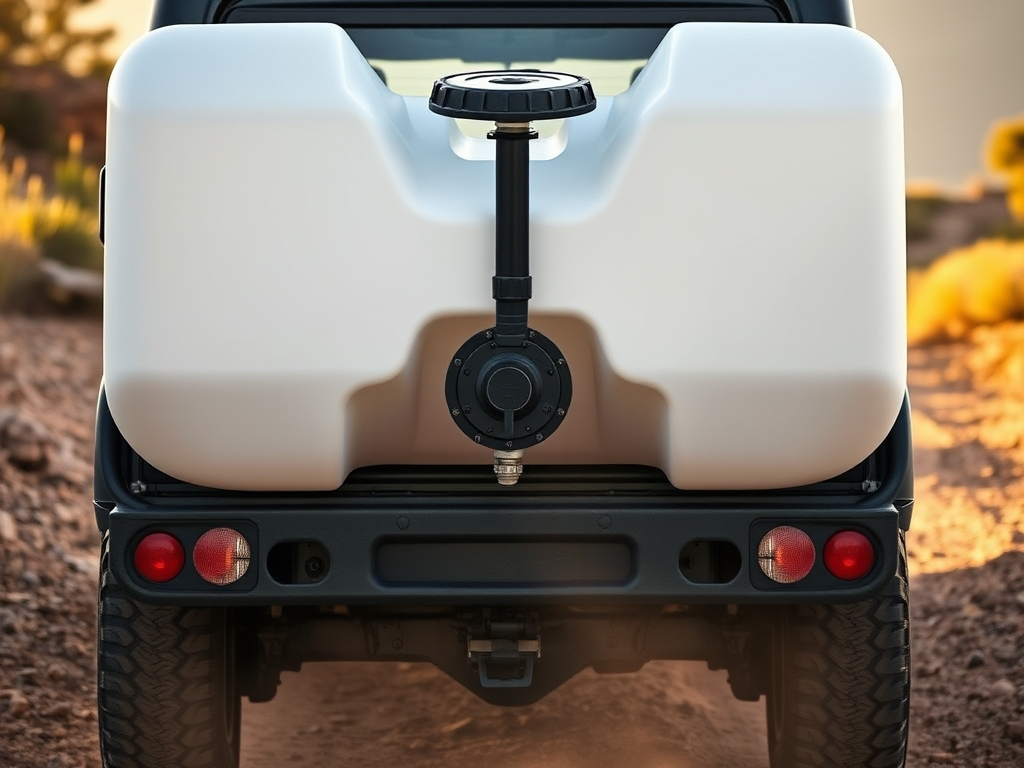
What is a water tank used for?
A water tank is a general-purpose storage vessel, used for drinking water supply, irrigation, fire suppression, farming, chemical manufacturing and food preparation. [1] On a touring setup the same idea scales down to a few jobs: drinking and cooking water, washing up, a rinse after a dusty track, and showers at camp.
A tank is not a treatment system. By design it should do no harm to the water, but water is exposed to bacteria, viruses, algae, pH changes, minerals and accumulated gas, and contamination can come from piping, tank construction materials, animal and bird faeces, and mineral or gas intrusion. [1] A correctly designed tank works to reduce those effects; it does not remove them for you.
The other thing a tank does is carry weight. Water is heavy, so where the tank sits matters as much as how big it is. Horizontal cylindrical tanks are often chosen for transport because their low profile and low centre of gravity help keep the vehicle, trailer or truck stable. [1]
What is a water tank made of?
Common tank materials include plastics (polyethylene and polypropylene), fibreglass, concrete, stone and steel, either welded or bolted, in carbon or stainless grades. [1]
For household-style indoor use—such as a sink, tap or shower—the ACT Government says a tank should be made from or lined with food-grade material, and a pump is needed to provide pressure. [2]
Material also decides how you maintain it. The NT Government’s guidance says empty plastic tanks should be anchored; concrete tanks should not be left to dry out because they may crack; tanks with a cone-scour base can be cleaned by opening the cleaning outlet to let water and sludge drain, then rinsing with a hose; and small flat-bottomed tanks can be drained, rinsed and tilted to empty. [3]
How does a water tank work?
A tank works in three steps: fill it, store it, get it out again.
Filling can be from a tap, a jerry can, or collected off a roof. Roof catchment is simple to estimate: the ACT Government says each square metre of roof collects 1 litre for every millimetre of rain. [2] Gravity does the rest, and gravity is also a delivery method. An elevated tank creates pressure at a ground-level outlet of 1 kPa per 10.2 centimetres of elevation, so a tank elevated to 20 metres creates about 200 kPa. [1] On a camper, that usually means a tank mounted high enough to run a gravity tap, or a low-mounted tank plumbed to a pump.
A pump is the other option. To use collected water inside a home, the tank should be food-grade and a pump will be required to provide water pressure. [2]
Delivery is where most touring annoyances live: a tank that gravity-feeds slowly, a pump that runs dry, or an outlet that sits below the sludge line. A tank with a drain or cleaning outlet low down makes the maintenance described below much easier. [3]
How do you keep stored water safe to drink?
The NT Government describes rainwater as a high-quality source with a lower contamination risk than surface water, but warns that this does not ensure safety and that contamination is not always visible. [3]
Before you install or use a tank, it should have a first flush device to remove dirty water and enough screening to keep bugs out. [3] Once it is running, the recommended routine is:
- Check every three months for mosquito larvae in the water, that inlets and outlets are covered to prevent mosquito entry, and that the strainer is clear of debris. [3]
- Check annually the level of sludge and internal cleanliness, and the structural condition. [3]
- Examine for sediment build-up every 2 to 3 years, or sooner if you see sediment in the water flow, and remove it. [3]
- Flush the pipes for a few minutes if the supply has not been used for 24 hours or more, because stagnant water in pipes can pick up copper or lead. [3]
- Clean the roof and gutters collecting the rainwater every three months, removing leaves, bird droppings and other organic matter. [3]
It is also desirable that tanks be cleaned annually to reduce the delivery of algae, bacteria and viruses to people or animals. [1] Algae growth mostly occurs at a pH between 8.2 and 8.7, so a neutral or lower pH helps reduce it, and monitoring pH is a practical way to keep an eye on stored rainwater. [1] If anyone becomes unwell after drinking from a tank, stop using it and see a doctor.
How big a tank do you need?
Sizing depends on the situation, but the ACT Government provides some benchmarks: a 1,000-litre tank fits a small space and supplies some water for a small garden; 5,000 litres is often used for a small garden and can be plumbed into a toilet or laundry; 25,000 litres can provide most of the water for a modest house and garden; and tanks of 50,000 litres or more are common on rural properties. [2]
A touring setup lives at the small end of that scale, but the same logic applies: count your daily use, multiply by the days between refills, and add a margin for hot weather and unexpected detours. Then check that the tank fits where you want it and that the mounting can bear the weight of a full tank; the ACT Government notes that installation may involve creating a hardstand for that weight, and the same idea applies to a tray or camper bracket. [2]
Options at a glance
| Brand | What they offer | Worth knowing |
|---|---|---|
| Kings | A camping and outdoor page for gas hot water systems, listing hot water units and bundled kits [4] | The listing covers heating water rather than storing it, so look through the wider range for tanks and check whether the gear suits your setup [4] |
| Dometic | A Water Tanks & Mounts category within its car camping hydration range [5] | The category is the place to check tank and mounting options; confirm fitment and availability in your region before ordering [5] |
Which option fits whom
Neither brand is a complete answer on its own, so match the product to the job you are actually short of.
If your problem is hot water at camp rather than storage — showers, washing up, a sink — Kings’ camping and outdoor range is organised around gas hot water systems, with units and bundled kits listed together. [4] Check whether the brand covers the storage side of your setup elsewhere in its range, and confirm current details and availability in your region on the site, since product listings change.
If you already have water and need somewhere to put it, Dometic’s car camping hydration range includes a Water Tanks & Mounts category, which is the logical starting point for tank and mounting options. [5] Check the listed fitment against your vehicle or camper before ordering, and confirm availability in your region.
If you are building from scratch, the practical order is to size the tank from your daily use and trip length, choose food-grade material for anything you will drink, plan how the water gets out (gravity tap or pump), and only then work out where it mounts. [2][1] Add a first flush device and screens if you plan to collect rainwater, and build the three-monthly check into your trip prep. [3]
Confirm current specifications, fitment and availability on the brand’s own site before you commit, since ranges and listings change.
Sources
- Water tank (Wikipedia) — Wikipedia
- Rainwater tanks and collectors — act.gov.au
- Rainwater tanks — nt.gov.au
- Kings official site — au.adventurekings.com
- Dometic official site — dometic.com
How we put this together: we compared these options using each brand's published product and policy pages and the references listed above. We haven't tested the products ourselves, and details such as prices and policies can change, so check the brand's site before you buy.
You may also find What is a Swag? Australian Camping Swags Explained and How does a camping fridge work? A practical guide useful.