
Are portable power stations worth it? For most Australian camping and touring setups, yes — if you are charging a fridge, lights, phones and a laptop rather than running an air conditioner or a big appliance. A power station is silent, burns no fuel and can be recharged from the vehicle or a solar panel. A generator runs on petrol or diesel and carries exhaust risk; a dual battery is the simplest way to keep a fridge cold while you drive.
What a portable power station is actually good for
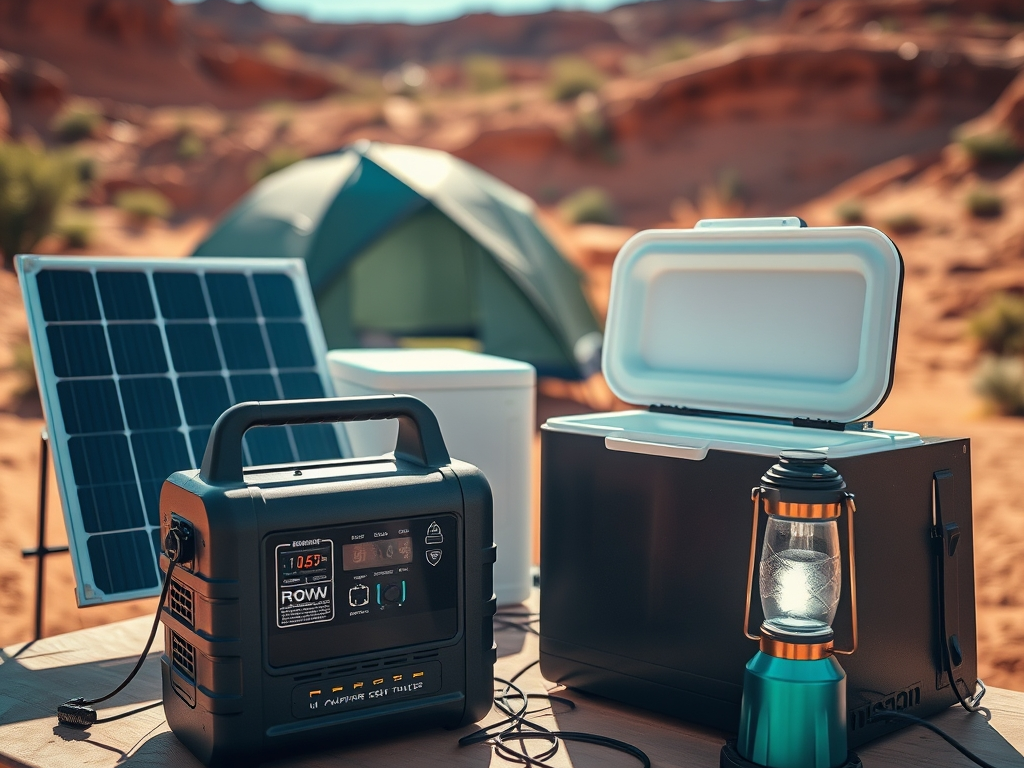
A power station stores energy in a battery and gives you standard 240 V outlets plus USB ports, without an engine. That single fact drives most of the practical advantages on a trip: you can run it inside a caravan, camper trailer or tent area without an exhaust plume, and you can top it up from a vehicle socket, mains power at a caravan park or a folding solar panel.
It also keeps your vehicle wiring untouched. A dual battery setup needs a charger, cabling and a mounting spot under the bonnet or in the tub; a power station is a box you carry in and plug in. For a weekend setup built around one fridge and a few devices, that simplicity is the whole argument.
Where it falls short is heavy, sustained loads. Anything that heats — kettles, induction cookers, hair dryers — drains stored energy quickly, and a small unit will trip out on output before it runs flat. Adding a second battery or a bigger unit costs more, so size honestly before you buy.
Where a generator still has the edge — and the rules that come with it
A fuel generator earns its place when you need a lot of power for a long time and can refuel: tools, a big caravan air conditioner, or a group camp where everyone wants 240 V. Run time is limited by fuel on hand rather than a battery’s state of charge.
The trade-off is safety. Queensland Health advises that generators running on petrol or diesel emit carbon monoxide and should only be used outdoors with good ventilation, away from windows and vents. [1] Carbon monoxide cannot be seen or smelled, and accumulation in a home, garage, or caravan can lead to sudden illness, unconsciousness, and death. [1] The guidance also states that generators should never be used indoors—including in a home, basement, garage, caravan, or tent—or outside close to an open window. [1]
Additional safety points: keep the generator dry and avoid using it in rain, turn it off before refueling, and never connect it to a wall outlet to power house wiring, as this can backfeed into power lines. [1] Installing battery-operated carbon monoxide alarms is recommended as a backstop. [1] A permanently installed generator should only be connected by a licensed electrician. [1]
If you camp in a swag, a rooftop tent or a caravan annexe, that outdoor-only rule is the strongest argument for choosing a battery-based system instead.
When a dual battery is the better spend
A dual battery system adds an auxiliary battery charged from the vehicle’s alternator, usually through a DC-DC charger, and often feeds a fixed fridge outlet and some 12 V sockets in the back. Its strength is that it charges while you drive, so a long touring day replaces the energy a fridge used overnight.
It suits readers who mostly move daily, want a permanent install, and run 12 V gear only. It is less flexible if you need 240 V for a laptop or camera charger — that needs an inverter, adding another component and more wiring to get right. It also ties your power to one vehicle, so it is no help around camp or in a second car.
Many tourers end up with both: a dual battery for the fridge in the vehicle and a power station for camp lighting, devices and a backup charge source. That combination covers the common failure far from help — a flat fridge battery with no sun for a day.
What the capacity and output numbers mean
Two figures decide what a unit can do. Watt-hours (Wh) is stored energy — how much you can use before it is flat. Watts (W) is the maximum draw it will supply at once, which sets whether a kettle, a charger or a fridge will start at all.
EcoFlow’s Australian range shows the spread clearly: the RIVER 3 lists 245Wh capacity and 300W output, the RIVER 2 Pro 768Wh and 800W, the DELTA 3 1024Wh and 1800W, the DELTA 3 (1500) 1536Wh and 1800W, the DELTA 2 Max 2048Wh and 2400W, and the DELTA Pro 3 4–12kWh with 4000W output. [2][3] The DELTA Pro Ultra is listed at 6–30kWh with 6900W output and 5,600W solar input. [2][3]
Solar recharging is the other number to check. EcoFlow’s solar generator bundles pair panels with the unit and list expected recharge times — for example, the DELTA 3 Max Plus solar generator with a 400W panel is listed at 6–10 hours of solar recharge. [2] Treat those figures as the best case and plan for less in winter or cloud.
Portable power options compared
| Brand | What they offer | Worth knowing |
|---|---|---|
| Kings | A portable power range on its Australian site, showing 28 products including bundle-and-save options [4] | Individual listings display customer ratings [4]; confirm specifications, warranty terms and shipping for your location on the site |
| Companion | The Rover Lithium 70Ah power station is the model listed on its site [5] | Shipping to Australia is not confirmed, so check availability and full specifications with the brand |
| EcoFlow | RIVER and DELTA ranges from 245Wh/300W up to 6–30kWh/6900W, plus solar generator bundles with listed recharge times [2][3] | Sold in Australia; EcoFlow describes itself as the global No.1 portable power station in sales [2], and a 2025 recall covered 25,000 DELTA Max 2000 units over fire risk [6] |
EcoFlow was founded in May 2017 by Bruce Wang and launched the DELTA Pro in 2021, and its products have taken Australian Good Design Awards, a Red Dot Design Award for the DELTA 2 series and an iF Design Award for its Power Kits. [6] The 2025 recall of DELTA Max 2000 units is worth checking against any second-hand or older unit you are offered. [6]
Which option fits whom
- Weekend camper with a fridge and phones: a mid-size power station sized to your fridge’s overnight draw, recharged while driving and topped up with a folding panel. Silent, no fuel, works inside an annexe.
- Long, hot stays in one spot with heavy loads: a fuel generator, run outdoors well away from windows and vents, with a carbon monoxide alarm in the living space and fuel stored safely. [1]
- Daily-driving tourer running 12 V only: a dual battery charged from the alternator, with a power station as backup for device charging and camp lights.
- Family with a caravan plus a second vehicle: both — a dual battery for the vehicle fridge and a power station that moves between the van, the 4WD and camp.
- Buying on brand history and support: EcoFlow publishes a return and refund policy on its Australian site [7] and states it is available in Australia [2]; for Kings and Companion, confirm regional availability and warranty directly, since shipping to Australia is not confirmed either way. [4][5]
A power station is not the only way to keep a fridge cold or a phone charged, but it is the quietest and the most portable. Confirm current models, capacities and shipping for your location on each brand’s site before ordering.
Sources
- Using alternative fuel and electricity generation safely during power outages – qld — qld.gov.au
- EcoFlow official site: Portable Power Stations | EcoFlow AU Page 3 — au.ecoflow.com
- EcoFlow official site — au.ecoflow.com
- Kings official site — au.adventurekings.com
- Companion official site — companionoutdoor.co.nz
- EcoFlow (Wikipedia) — Wikipedia
- EcoFlow: Return & Refund Policy — au.ecoflow.com
How we put this together: we compared these options using each brand's published product and policy pages and the references listed above. We haven't tested the products ourselves, and details such as prices and policies can change, so check the brand's site before you buy.